


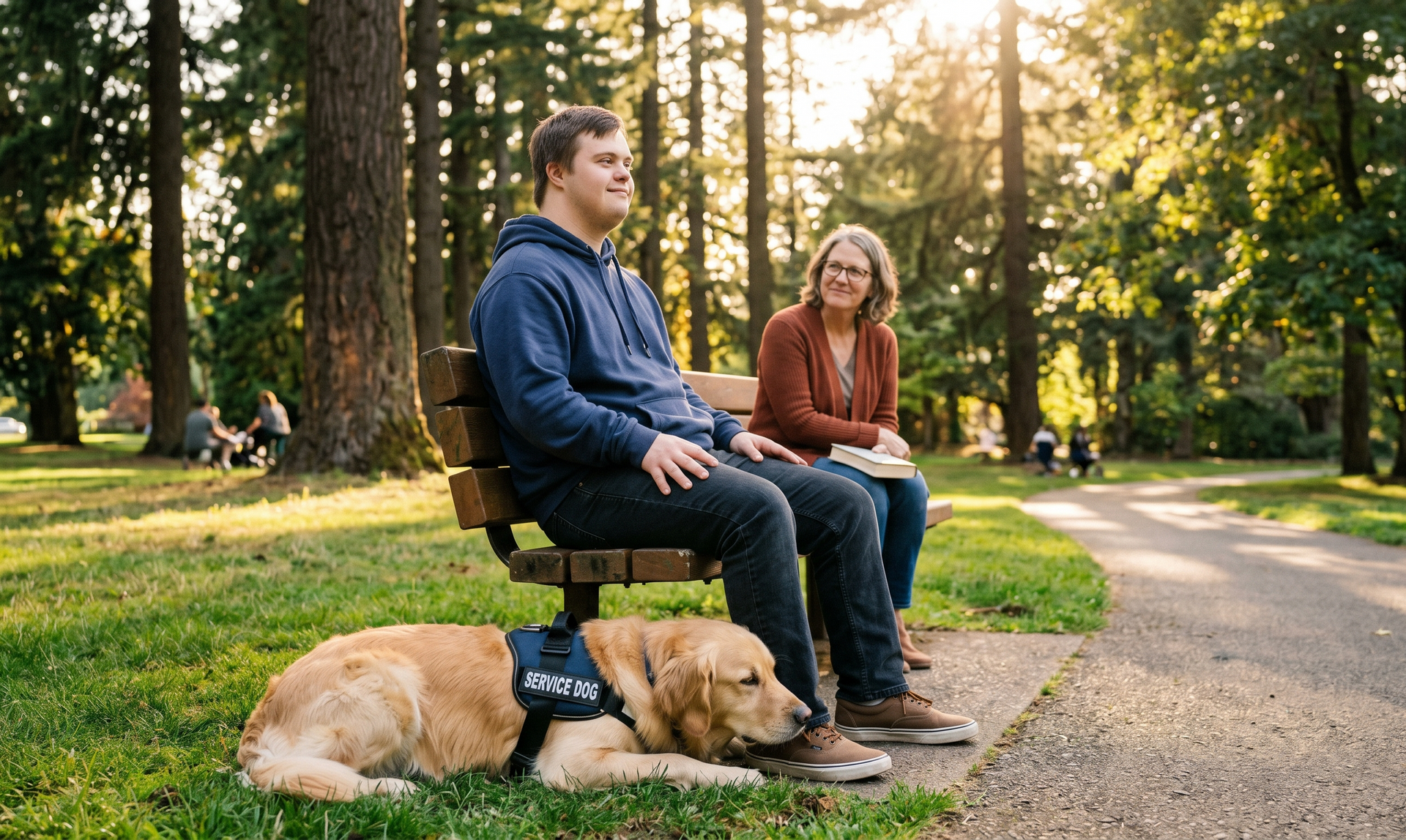
Service Dogs, Therapy Animals, and Companion Pets: A Guide for Oregon Families Supporting Loved Ones with I/DD
There is something quietly powerful about the relationship between a person with a developmental disability and an animal they love. A dog who lays his head on a child's lap during a hard transition. A cat who knows, somehow, when to climb onto the lap of a young adult who has had a rough morning. A pony who waits at the fence for the same hand and the same carrot every Tuesday. Animals can offer companionship that does not depend on words, a daily rhythm that grounds a household, and — in some cases — formally trained assistance that opens doors that were once closed.
This guide is for Oregon families who are thinking about whether an animal might fit into the life of someone they support. We will walk through the legal categories, what each kind of animal can and cannot do, what to consider before bringing one home, and where families in our region have found support.
The Three Categories, Clearly Distinguished
A lot of confusion in this space comes from blurring three very different roles. Each is real and valuable, but they live in different parts of the law and the day-to-day.
Service animals, under the Americans with Disabilities Act (ADA), are dogs (and in narrow cases, miniature horses) individually trained to perform specific tasks for a person with a disability. The tasks must be directly related to the person's disability. Examples for someone with I/DD might include interrupting self-injurious behavior, providing tactile grounding during a sensory crisis, retrieving a communication device, alerting a caregiver to a seizure, or performing a trained search-and-locate response if the person elopes. Service animals have full public access rights — they may accompany the handler into stores, restaurants, schools, medical offices, and on public transit. They are not pets in the eyes of the law; they are working partners.
Emotional support animals (ESAs) provide comfort by their presence. They are not required to be trained in specific tasks, and they do not have the public-access rights of service animals under the ADA. They do, however, have certain federal housing protections under the Fair Housing Act — a landlord generally cannot refuse to rent to someone with an ESA, even in a no-pet building, with proper documentation from a treating provider. Following 2021 federal rule changes, ESAs no longer fly in the cabin as service animals on most U.S. airlines; they are typically subject to standard pet policies.
Therapy animals are pet animals (most often dogs, sometimes cats, rabbits, horses, or guinea pigs) trained and registered through organizations like Pet Partners or Therapy Dogs International to make visits to schools, libraries, hospitals, and day programs. They belong to their handler and are at home as a pet, but they have been temperament-tested and prepared to do structured visits. Therapy animals do not have ADA public access rights; they are guests in the spaces that invite them.
And then there is the fourth, often most important category for many families: the beloved pet — the household dog, cat, or other companion who is not trained for any formal role and is, simply, family. We will come back to this one, because it is the option that fits the most households.
When a Service Dog Might Be a Good Fit
A service dog can be life-changing for a person with I/DD, especially when there are specific, predictable tasks the dog can perform. Some examples we have heard from Oregon families:
- A dog trained to perform deep-pressure therapy when their handler shows early signs of a meltdown
- A dog trained to tether to a child known to elope, providing a physical and sensory cue that helps the child stay with their family in public
- A dog trained to alert family members to seizures in time to provide safe positioning
- A dog trained to retrieve dropped items, open accessible doors, or carry small medical supplies for an adult with mobility needs alongside I/DD
- A dog trained to interrupt a specific stereotyped behavior that causes injury
Service dogs are also a significant commitment. A properly trained service dog from a reputable program in the Pacific Northwest typically takes 18 to 24 months to train and can cost $20,000 to $50,000, though many programs operate on a donation or scholarship basis. Once placed, the dog needs ongoing training maintenance, veterinary care, food, equipment, and a daily working life — a service dog is not "off duty" the way a pet is. Oregon programs and Pacific Northwest neighbors families have worked with include Joys of Living Assistance Dogs (JLAD) in West Linn and Brigadoon Service Dogs based in Washington, among others. Wait times can be long. Plan years ahead.
One important note: there is no legitimate "registration" of service animals under the ADA. Online sites that sell certificates and vests are not awarding legal status — service animal status comes from the dog's actual training to perform disability-related tasks, not from a card in a wallet. Anyone who suggests otherwise is not a reliable source.
When a Therapy Animal Visit Might Be Right
Therapy animal visits are one of the most accessible ways to bring the benefits of animal contact into a person's life without the responsibilities of owning a service dog. At North Star Oregon's Day Support Activities programs, animal visits — at farms, at programs that bring trained therapy dogs to community spaces, or through volunteer activities with horse rescues and animal shelters — are a regular part of how we build community access, sensory regulation, and joy into the week.
Many Oregon libraries host "read to a dog" programs through Pet Partners or similar groups. These are wonderful for individuals who are working on communication skills in a low-pressure environment. Hospitals and senior living communities also use therapy animals; some Oregon hospice programs include pet visits as part of end-of-life care. Equine-assisted activities and learning programs — there are a number across the Willamette Valley — offer a different kind of partnership again, one that combines physical work, sensory input, and relational connection.
Therapy animal contact does not need to be formal to be meaningful. A weekly visit to a friend's farm, a regular stop at a neighbor's barn, or a structured volunteer shift at an animal shelter can all build the same benefits.
When a Beloved Pet Is the Right Answer
For most households we work with, the right answer is not a service dog and not a registered therapy team. It is a pet — a family dog, a cat who picks the most-loved couch, a parakeet whose chirping is the soundtrack of the kitchen, a rabbit whose feeding routine has become the way mornings start. These animals do not have legal categories. They have something better: a place in the life of someone who loves them.
The benefits documented in research and reflected in our work with Oregon families include:
- Lower baseline anxiety and improved emotional regulation, especially in homes where the pet is part of predictable daily routines
- Opportunities for skill-building — feeding, grooming, walking, vet visits — that translate into independent living and employment readiness
- Social bridges in the community: the dog at the park, the cat at the window who greets neighbors, the conversations that start with "how old is your dog?"
- A non-judgmental source of physical contact and presence, which matters especially for individuals who find human touch overwhelming or who have limited access to peer relationships
- A reason to go outside, to move, to come home
If you are considering a pet, the questions worth asking are practical ones, not symbolic ones. Who will do the feeding, walking, cleaning, vet runs? Can the person you support participate in the animal's care, and in what specific ways? What happens during respite or when the family is traveling? Is the home environment safe for the kind of animal you are considering? And honestly: does the person actually want this animal, or is this a project the family is excited about? Pets brought into a household where the person with I/DD has not been consulted, or where the household is already at capacity, can become one more stressor rather than a source of joy.
Considerations Specific to I/DD
A few things worth thinking through that families sometimes overlook:
Allergies and sensory differences. Some individuals with I/DD have significant sensory sensitivities to animal hair, dander, or sound. A barking dog or a cat in motion can be deeply dysregulating for someone with auditory or visual processing differences. Spend time around the kind of animal you are considering before committing. Some families do well with a quieter species (a small dog versus a Labrador; a low-shedding breed; a fish tank) rather than no animal at all.
Behavior matching. Match the animal to the person, not the picture in your head. A high-energy adolescent dog is a different animal than a settled five-year-old. Adoption from a reputable shelter or rescue with experience matching animals to families with disabilities is often a better path than buying a puppy whose adult temperament is unknown. Greenhill Humane Society in Eugene, Willamette Humane Society in Salem, and Heartland Humane in Corvallis are familiar to many Oregon families.
Safety planning. Animals interact with elopement risk in complicated ways. Sometimes a dog is a calming anchor that reduces elopement; sometimes a new pet adds a fresh draw that pulls the person toward an open door. Build the animal into the wandering and safety plan we have discussed in previous posts, and update door alarms and yard fencing as needed.
Caregiver capacity. Caregivers — parents, adult siblings, DSPs — are the ones who pick up the slack of pet ownership when the person they support cannot fully care for the animal. Be honest about whether you have that capacity right now. The right answer might be "yes, in two years, after [Name] is settled in their day program" rather than "yes, now."
Housing protections. If you live in Oregon rental housing, landlords cannot generally charge pet deposits or pet rent for service animals or, with proper documentation, emotional support animals. Federal Fair Housing Act protections apply. The Fair Housing Council of Oregon is a resource if you encounter pushback. Be prepared with documentation from a treating provider for ESAs.
A Word About Cost and Coverage
Service dogs are not covered by Medicaid in Oregon, and they are not paid for through the K Plan or 1915(c) waivers. Some programs offer scholarships, fundraising support, or sliding-scale fees, and many families fundraise through their networks. The Oregon ABLE Savings Plan can be used to save for disability-related expenses including service animals, training, and ongoing care, with tax advantages and no impact on benefits eligibility (subject to ABLE program rules). For therapy animal visits and Day Support Activities that include animal contact, those services can be part of authorized DSA hours if they are structured into the program design.
Bringing It Together
The thread through all of this — service animals, therapy animals, pets — is that animals can be one of the most accessible ways for people with I/DD to experience companionship, sensory grounding, daily structure, and connection to the world around them. The right animal, for the right person, at the right time can change a life. The wrong animal, brought in for the wrong reasons, can add stress to a household that does not need more stress.
Whatever you are considering, take it slowly. Talk with the person you support, in the ways they communicate. Visit animals before committing. Talk with families who have walked this path. And remember that an animal's role in someone's life does not need a legal label to be meaningful.
Learn More
If you are an Oregon family thinking about whether community-based programming with regular animal contact — at farms, with therapy dog visits, through volunteering at animal shelters or rescues — might fit your loved one's life, North Star Oregon would love to talk. Our Day Support Activities programs in Albany, Corvallis, Eugene, Springfield, Salem, and Tangent build animal experiences into our regular community access, and our In-Home Attendant Care team can help integrate pet care routines into daily skill-building at home. We support children, adults, and seniors with intellectual and developmental disabilities across Oregon. Visit northstaroregon.com or give us a call to start the conversation.


Summer Safety for Individuals with I/DD: A Caregiver's Guide to Heat, Hydration, and Sensory Comfort