

Fall Prevention for Adults with I/DD: A Practical Guide for Oregon Families and Caregivers
Falls are one of the most under-discussed health risks facing adults with intellectual and developmental disabilities (I/DD). They are also one of the most preventable. Yet in conversations with the Oregon families we support — in homes across Albany, Corvallis, Eugene, Springfield, Salem, and Tangent — we hear the same story again and again: a parent or Direct Support Professional notices a "near miss" on the stairs, brushes it off, and a week or a month later that near miss becomes a real fall, with real injuries, a real ER visit, and a long, painful recovery.
Older adults are not the only ones who fall. Younger adults with I/DD experience falls at rates significantly higher than the general population — driven by factors like medication side effects, seizure disorders, balance and coordination differences, sensory processing differences, vision and hearing changes, and the home environments many of us inherited rather than designed. Cerebral palsy, Down syndrome, autism, and many other conditions also affect gait, balance, and proprioception in ways that increase fall risk across the lifespan.
The good news: most falls are preventable with thoughtful planning. This guide walks through the most common fall risks for adults with I/DD, what to look for in the home, and how to build a fall prevention strategy that works for the individual you support — without making the home feel like a hospital.
Why Falls Matter More Than Most Families Realize
A single significant fall can change everything for an adult with I/DD. A broken hip can require surgery, rehab, and weeks of immobility, which often leads to deconditioning, pneumonia, pressure injuries, and the loss of independent skills that took years to build. A head injury can cause cognitive changes that are hard to distinguish from baseline differences and may go undiagnosed for weeks. Even a fall that produces "only" bruises can trigger lasting fear, reduced activity, and a downward spiral in confidence and mobility.
For individuals who have limited communication, a fall can also be invisible. Pain may show up as behavioral change — irritability, sleep disruption, refusal to walk — rather than a clear "I hurt my hip." Caregivers who know the person well are often the first line of detection, but only if they are looking.
The cost is not only physical. For families who are the primary caregivers, a serious fall often means weeks of additional medical appointments, missed work, and emotional strain. For provider organizations, it can trigger incident reports, investigations, and changes to the Individual Support Plan. Preventing falls is one of the highest-leverage health and safety investments any family or care team can make.
Common Fall Risk Factors in Adults with I/DD
Fall risk is almost never one cause. It is usually a combination of factors that, on a bad day, add up to a fall that wouldn't have happened on a good day. The strongest prevention strategies address several factors at once.
Medications. Many medications commonly prescribed for adults with I/DD — including seizure medications, psychiatric medications, sleep aids, blood pressure medications, and some pain medications — list dizziness, drowsiness, or balance disturbance as side effects.
Polypharmacy (being on multiple medications at once) compounds the risk. An annual medication review with the prescribing provider and pharmacist — specifically asking about fall risk — is one of the most evidence-based things a family can do.
Vision and hearing. Many adults with I/DD do not receive regular vision and hearing exams, often because the exams themselves are hard to access or hard to tolerate. Uncorrected vision changes — especially in low light or with bifocal lenses that distort stair edges — are a major fall risk. Hearing loss makes it harder to perceive ambient cues that warn of obstacles. Annual exams with a developmental specialist optometrist or audiologist are worth the effort.
Foot health. Bunions, ingrown toenails, calluses, poorly fitting shoes, and untreated foot pain all change how someone walks. Many adults with I/DD wear shoes that don't fit well — either because of sensory preferences, because foot growth went unnoticed, or because nobody has been doing regular foot checks. Slippers without backs, socks on hardwood floors, and worn-out shoes are particularly hazardous.
Seizures. For adults with seizure disorders, falls during seizures are a separate and serious category of risk. Helmet use, padded environments in high-risk areas, and seizure detection devices may all be appropriate depending on seizure type and frequency. Coordinate closely with the neurology team.
Sensory and cognitive factors. Differences in proprioception (knowing where your body is in space), vestibular processing (sense of balance), and depth perception are common in many I/DD profiles. So is impulsivity that may lead someone to stand up quickly, miss a step, or refuse a needed mobility aid. These are not character flaws — they are real physical differences that benefit from environmental adaptation.
Mobility changes over time. Many adults with I/DD experience changes in mobility as they age, sometimes earlier than the general population. A person who has used a walker for years may benefit from a wheelchair for longer distances. A person who has always been ambulatory may need a gait belt or a mobility aid for stairs. Accepting these changes and adapting equipment is a sign of good care, not a step backward.
A Room-by-Room Home Safety Audit
The single most actionable step any family can take is a thorough walk-through of the home, room by room, looking for fall hazards. We recommend doing this with the individual themselves whenever possible — they know what trips them up, what feels wobbly, and what they secretly avoid because it scares them.
Entryways
The transition from outdoors to indoors is one of the highest fall-risk zones in any home, especially in Oregon, where wet shoes meet smooth floors for nine months a year. Place industrial-grade no-slip mats both outside and inside every entry. Install grab bars or sturdy handrails on any step. Make sure entryway lighting comes on immediately — motion-sensor lights are a small investment with huge payoff. Designate a seat where the person can sit to remove shoes, with shoes stored within reach.
Hallways and Living Areas
Walk every common path your loved one takes through the home. Are there cords across the floor? Throw rugs that slide or curl at the edges? Furniture corners at hip or shin height? Pet bowls, toys, or charger cables underfoot? Many of these are easy fixes — secure or remove rugs, tape down cords, rearrange furniture so the path is clear, designate a single "pet zone."
Lighting matters enormously. Many homes have shadows, dim corners, and inconsistent lighting that an adult with vision differences can easily misread. Add night lights in hallways, bathrooms, and bedrooms. Consider motion-sensor lights so the person doesn't have to fumble for switches in the dark.
Bathrooms
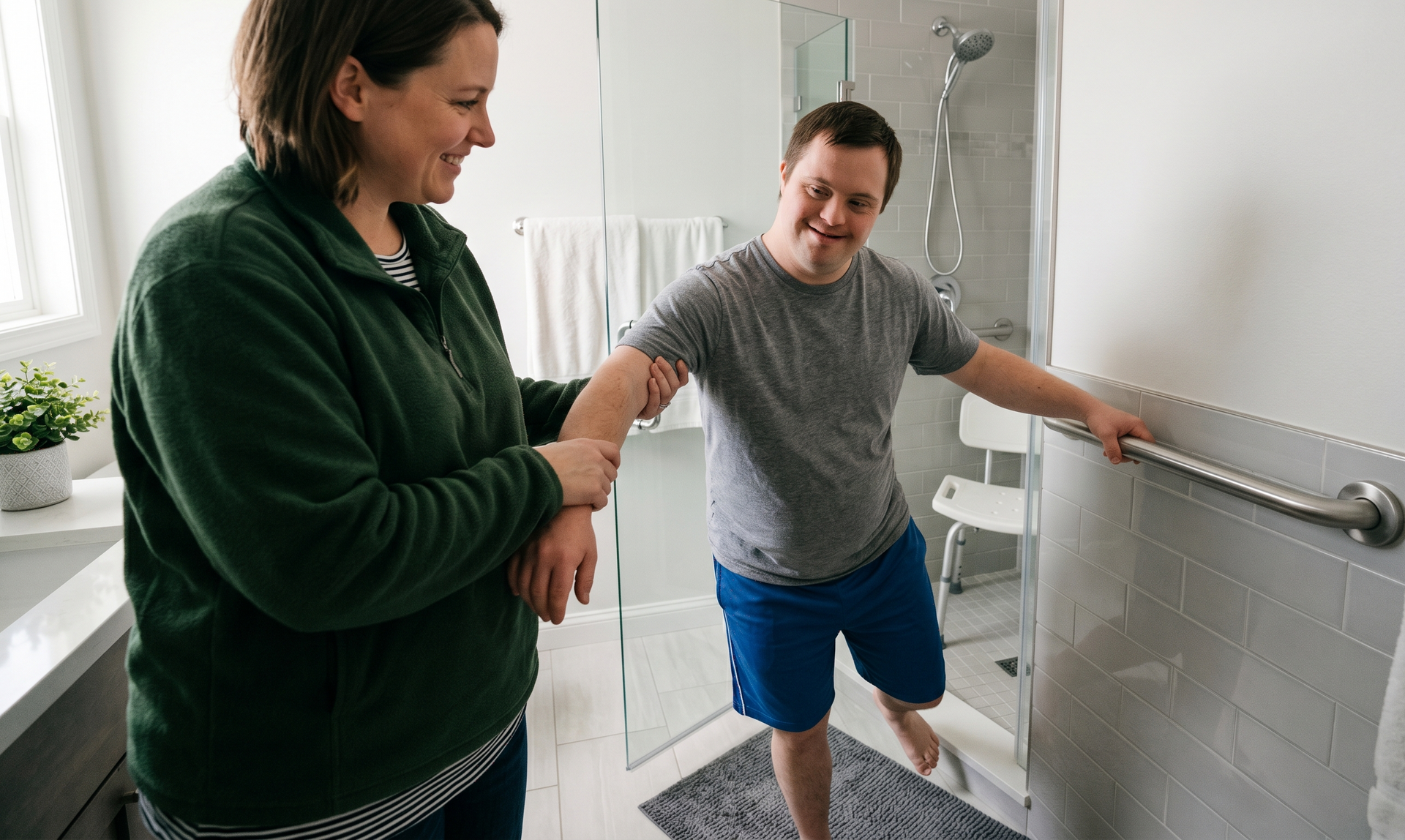
The bathroom is statistically the most dangerous room for falls. Wet floors, hard surfaces, transitions between standing and sitting, and tight spaces all conspire against safety. Grab bars near the toilet and inside the tub or shower — installed into wall studs, not just attached with suction cups — are essential for any adult with mobility or balance differences. Non-slip mats inside the tub, a non-slip bath rug outside it, and a stable shower chair or bench all reduce risk dramatically.
For many adults with I/DD, a walk-in shower is safer than a step-over tub. If a tub is the only option, a transfer bench can dramatically reduce risk. Raised toilet seats with armrests help adults who struggle with the sit-to-stand transition. Avoid leaving towels, bathmats, or clothing items in places that might be stepped on accidentally.
Bedrooms
Beds at an appropriate height — neither too low to easily get out of, nor too high to safely get into — are the foundation of bedroom safety. A bed that the person can sit on with feet flat on the floor and hips slightly higher than knees is usually ideal. Clear paths from the bed to the bathroom, with night lights along the route. Avoid throw rugs in the bedroom entirely. For individuals who get up multiple times at night, consider a bedside commode if the bathroom path is long or hazardous.
For individuals at risk of rolling out of bed, bed rails or pool-noodle bumpers under the fitted sheet can help. For individuals who have fallen from bed in the past, lowering the bed and placing a fall mat alongside it can reduce injury severity.
Stairs
Stairs are non-negotiable territory for safety attention. Sturdy handrails on both sides of every staircase. Non-slip strips or carpet on every tread. Excellent lighting at the top and bottom, with light switches on both ends. A clear, decluttered staircase — no laundry baskets, shoes, or items "to bring upstairs next time." For individuals with significant fall risk, gates at the top and bottom of stairs may be appropriate, just as they are for young children.
If stairs become persistently challenging, it is worth considering whether the household can be restructured so that the person's bedroom, bathroom, and primary daily activities are all on one level. Sometimes a stair lift is the right answer; sometimes a moved bedroom is.
Kitchens
Wet floors, items stored too high or too low, and the temptation to climb on something to reach a high shelf are the main kitchen risks. Keep frequently used items between waist and shoulder height. Use sturdy step stools with handles — never chairs — for higher items, and ideally have a caregiver assist. Clean spills immediately and consider replacing slippery flooring with textured or rubberized alternatives.
Building a Fall Prevention Plan
A formal fall prevention plan can be part of the Individual Support Plan (ISP) and can include the home modifications above plus the following:
Regular medication reviews with the prescribing provider, with a specific request to evaluate fall risk and consider deprescribing where appropriate. Annual reviews at minimum; more often if medications change.
Annual vision and hearing exams with providers experienced in working with adults with I/DD. For some individuals, exams may need to be done in stages or with sedation, but they remain worth doing.
Annual foot care exam with a podiatrist, plus a regular at-home foot check by a Direct Support Professional or family member. Many issues can be addressed at home before they become walking problems.
A physical therapy evaluation, particularly after any change in mobility, fall, or hospitalization. A PT can assess balance, gait, and strength and recommend exercises that fit the individual's interests and abilities. Adapted yoga, swimming, walking programs, and balance exercises can all help.
A mobility aid plan that respects the individual's preferences. The "right" mobility aid is the one the person will actually use. Many adults with I/DD resist canes or walkers because they feel stigmatizing or unfamiliar; involving the person in choosing equipment and giving them time to adapt makes adoption much more likely.
Documentation and tracking. When falls do happen, document them: date, time, location, what the person was doing, what they were wearing, who was present, what injuries occurred, and what the suspected contributing factors were. Patterns often emerge over time that are not visible from a single event.
When a Fall Happens
Despite the best prevention plan, falls will sometimes happen. When they do:
Do not immediately move the person. Especially if there is any suspicion of head, neck, back, or hip injury. Stay with them, talk calmly, and assess for injury. Call 911 if there is any sign of serious injury, loss of consciousness, severe pain, or inability to move a limb.
After a fall, watch closely for 24–48 hours. Concussion symptoms can be delayed and may include behavior changes, confusion, headache, sleep disruption, or balance changes. For individuals with limited communication, behavioral changes are often the most important warning sign.
Document the event and conduct a debrief. What was happening? What might have prevented it? Update the fall prevention plan accordingly. Notify the Services Coordinator, family members, and provider team as appropriate.
How North Star Oregon Supports Fall Prevention
For the individuals and families we support, fall prevention is woven into our In-Home Attendant Care planning and into the safety practices of our Day Support Activities sites. Our Direct Support Professionals receive training in safe transfers, ambulation assistance, recognizing signs of pain in non-speaking individuals, and incident documentation. When new mobility or health changes occur, we work with the family, the Services Coordinator, and the medical team to update the ISP and adjust supports.
We also partner with families to do home safety walk-throughs, identify modifications that can be made, and connect with resources like the Oregon Vocational Rehabilitation Services and Medicaid environmental modification benefits that can help fund larger home accessibility projects.
Taking the First Step
If you have not done a fall prevention walk-through of your home in the last year, this week is a good time. Pick one room, start there, and work your way through the house over a few weekends. Talk with your loved one about what feels unsteady to them. Notice what shoes they are wearing day-to-day. Check the bottoms for tread, the inside for wear, and the size for fit. Take one phone call — to the primary care provider, to a physical therapist, to a podiatrist — to start a conversation that's been on the list for a while.
Preventing one fall can preserve months of mobility, independence, and confidence. It is some of the most important quiet work that families and care teams do.
If you are an Oregon family supporting an adult with I/DD and want to learn more about how In-Home Attendant Care or Day Support Activities can include health, safety, and fall prevention planning as part of person-centered care, reach out to North Star Oregon. We would be honored to learn about your loved one and explore how our team can support the kind of life they want — safely, confidently, and on their own terms.


Summer Safety for Individuals with I/DD: A Caregiver's Guide to Heat, Hydration, and Sensory Comfort